On-Page SEO: Optimizing a Page, Step by Step
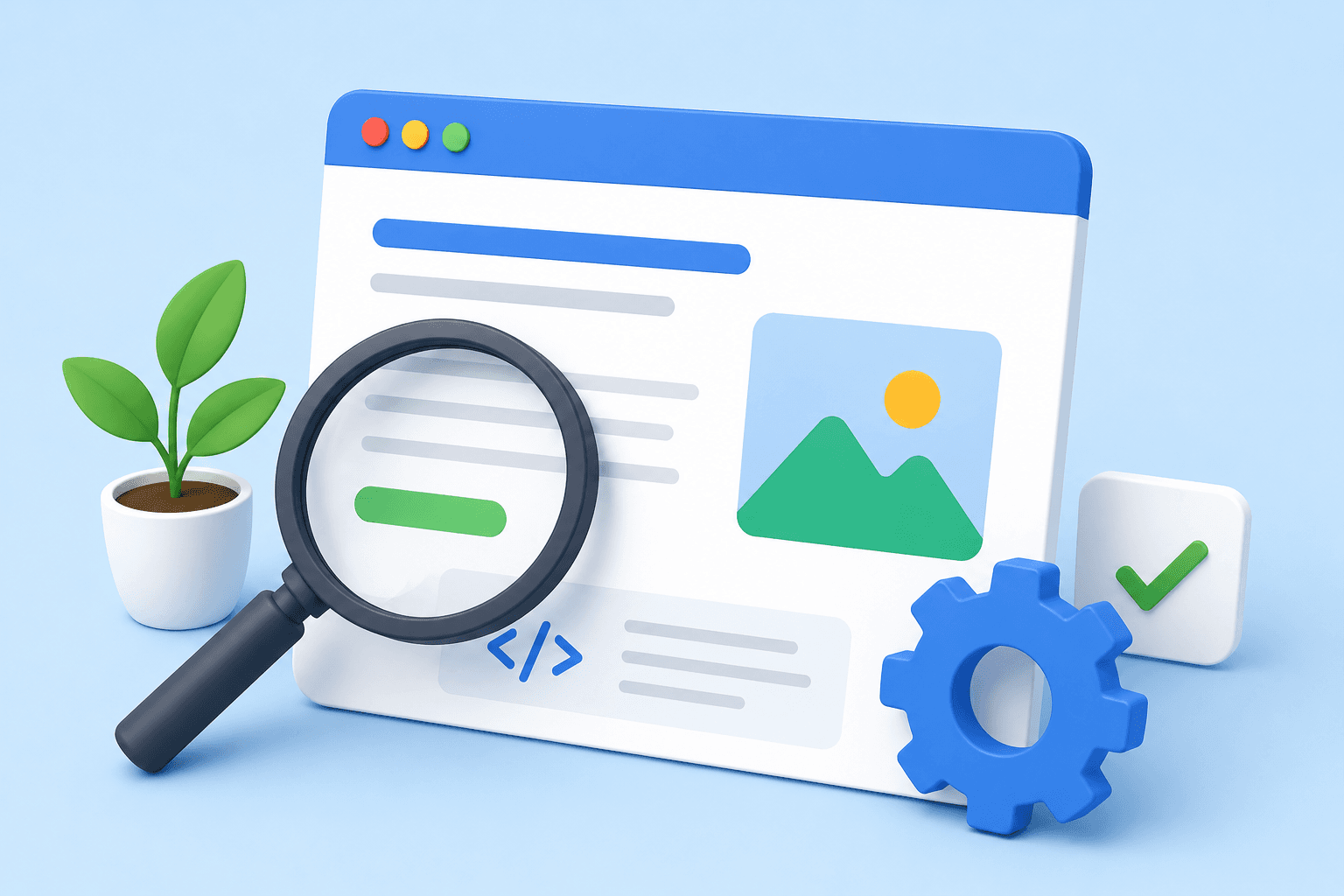
On-page SEO is everything that happens on the page itself to help search engines understand it. No mysterious settings, no hidden tricks: it's about the title, the text, the images, the links and the structure — in other words, the elements you control entirely.
It's also the most reassuring part of SEO, because it depends on nobody but you. Here, step by step, is how to optimize a page without being a technician.
The title tag and meta description
When your page appears in search results, two elements decide whether someone clicks: the title tag and the meta description.
The title tag is the clickable line, shown in larger text. It should clearly say what the page is about and, if possible, include the word your customers type. For a tradesperson, "Plumber in Leeds — fast callouts, 7 days a week" is far more telling than a plain "Home".
The meta description is the short text shown just below. It doesn't directly affect ranking, but it makes people want to click. Think of it as a small advert: describe in one or two sentences what the visitor will find, and end with a reason to come to you.
Avoid identical titles across several pages. Each page deserves its own title, precise and unique.
Headings and structure
A well-structured page reads like a clear document, with a main title and sections.
The basic rule: only one H1 per page. That's the main heading, the one that sums up the topic. Then H2 subheadings divide the page into major parts, and H3 headings into smaller parts if needed. This hierarchy isn't decorative: it helps the reader skim the page, and it helps search engines understand how your content is organized.
Picture a hurried visitor scanning your page. If they grasp the outline just by reading the headings, you've succeeded. If not, the structure needs to be clearer.
Clear, readable URLs
The URL is the page's address. It matters too, and it's better off simple.
A good URL is short, descriptive and free of clutter. An address ending in "/bike-repair-bristol" makes sense at a glance. An address full of numbers and symbols, by contrast, tells nobody anything.
- Keep words, not codes or numbers.
- Separate words with hyphens.
- Stay short: the heart of the topic is enough.
- Avoid changing an existing URL without reason, because old links would stop working.
Images and alt text
Images bring a page to life, but they call for two kinds of attention.
The first is weight. An image that's too heavy slows the page down, and slowness drives visitors away. Before putting a photo online, reduce its size to what's actually needed.
The second is alt text, sometimes called the alt attribute. It's a short written description of the image. It helps people who use a screen reader, it shows up if the image fails to load, and it lets search engines understand what the photo shows. Describe the image plainly, as you would explain it to someone on the phone: "homemade apple pie on a wooden table".
Internal linking
Internal linking means the links that connect your own pages to each other. It's one of the simplest and most overlooked levers of on-page SEO.
When an article points naturally to another useful page on your site, you help the visitor keep reading and you show search engines how your content fits together. This is exactly what the articles on this blog do with one another.
For instance, an article about writing builds usefully on finding the keywords your customers actually type, since you always write around a specific topic. Likewise, a page can point to the method for writing content that ranks when the subject of writing comes up. What matters is that the link text describes the destination page, never a vague "click here".
Speed is part of the page
A fast page is simply a better page. Loading time isn't separate from the rest: it's part of the experience you offer.
You can get your title, your structure and your images right, and ruin it all with a page that takes eight seconds to appear. To go further on this point, see why a fast site changes everything.
All these elements form a coherent whole, and on-page SEO is itself only one part of a broader strategy. Our complete guide to making your website visible shows how this piece fits with the others.
Optimizing a page mostly takes method and a little proofreading. If you want to save time, describe a page to semchat: it reviews it, spots what's missing or what could be improved, and tells you exactly what to fix, in plain language.
Turn theory into action
Ask semchat your question and get a clear action plan for your site in seconds.
Try semchat